Before the Hobby Store: How Home Handcraft Became Leisure
Home handcraft as leisure grew alongside domestic work, not after it vanished. See how changing purposes can help you shape a satisfying craft practice.
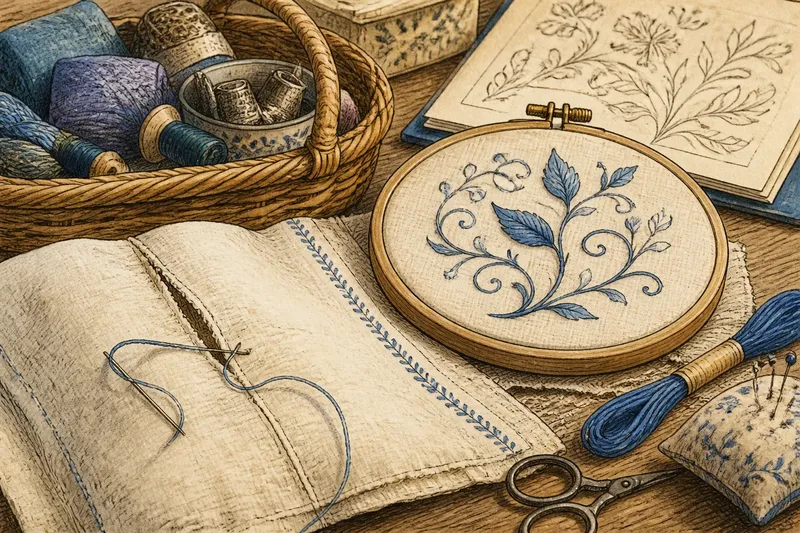
A mending basket sits beside an embroidery hoop: one holds a split seam to fix, the other a pattern chosen for its curling leaves. Home handcraft as leisure has no single starting date; the distinction lies in why a person takes up the needle. Across different places and periods, practical work and chosen making have often shared the same table.
How did home handcraft become leisure?
There was no clean moment when household crafts stopped being work and became hobbies. In households where people made or repaired clothing, linens, baskets, and other useful goods, such tasks answered immediate needs. A maker could take pride in skill or enjoy a satisfying rhythm, but pleasure did not necessarily make the work optional.
Leisure entered the picture when a person had room to choose a project, its purpose, or the time spent on it. That room varied by household and circumstance. Practical demands continued, while some making also served ornament, experimentation, or the enjoyment of learning a technique.
The same craft could hold both purposes. A useful cloth might receive decorative embroidery, or a garment might be knitted in a new pattern. The shift was not from drudgery to fun for everyone; it was a gradual expansion of what making could mean.
Why did the home shape a craft practice?
Domestic making had to fit around other responsibilities. Sewing baskets, spinning wheels, and other tools could be brought out when time allowed and put away when the table was needed for something else. In a shared home, a lamp, a quiet corner, or a box for supplies could help turn scattered work into a chosen practice.
Access to ready-made goods or help with household work could give some people more freedom to choose decorative or experimental projects. But those options were not equally available, and they did not erase necessary work. It is more accurate to see domestic craft as a mix of obligation and choice than as a single historical transition.
A small container can still give a hobby its own place: keep embroidery floss in a tin, patterns in a folder, or beads in a tray.
What did patterns and instruction make possible?
Printed patterns, instruction books, demonstrations, and shared know-how offered ways to encounter techniques beyond a person’s immediate household. Shops and mail-order catalogs could connect makers with tools and materials, though access depended on location and means. These channels widened possibilities without making every project easy or available to everyone.
Instructions provided a starting point, not a rule about what a maker should value. Someone might follow a design closely, change its colors, or set it aside. A printed pattern could make an unfamiliar stitch imaginable; the pleasure might come from the finished piece, the practice, or simply the attempt.
Use a pattern as a source of ideas, not as a verdict on your skill.
How can you tell whether a craft is need or leisure?
Look at the choices around the task, not just its materials. Necessary work is judged by whether it solves a problem; chosen practice can also be valued for attention, repetition, or discovery. Many projects combine both, and neither purpose is more worthy.
Say you have a cushion cover with a split seam and a small amount of blue thread. First, you sew the seam closed so the cushion can be used again. Then you decide to add a simple blue border with a decorative stitch because you want to practice it. The repair meets the need; the border adds a chosen experiment. If the extra stitching begins to feel like an obligation, you can stop after the repair and still have completed the useful task.
What do people ask about home handcraft as leisure?
Was domestic craft always a hobby?
No. Many crafts were necessary household labor, even when makers took pride in their skill or enjoyed parts of the process. They also became leisure when people could choose them, at least in part, for interest rather than immediate need.
Did ready-made goods end home making?
No. Purchased goods could reduce some tasks while leaving repair, decoration, and experimentation. The balance between choice and necessity differed from one household to another.
Why did printed patterns matter?
Patterns and instruction books helped designs and techniques travel beyond direct teaching within a household or local circle. Readers could try, adapt, or ignore a project according to their interests and circumstances.
How can a useful craft feel less like a chore?
Keep necessary work simple, then choose one optional element for curiosity, such as a different stitch or color. If the experiment adds pressure, set it aside; the practical task can still be finished.
How can you shape a craft around choice?
Home handcraft as leisure is best understood not as a replacement for chores, but as another purpose that could share the same tools and skills. A project might meet a need, express taste, invite practice, or do several things at once. Noticing which purpose matters most can help you choose what to make and when to stop.
- Check the project’s immediate purpose: If an item must be repaired or finished for use, do the necessary part first; if there is no pressing need, choose a project for interest.
- Check how much time you want to give it: If a small session suits you, set out only the materials for that portion; if you want a longer stretch, prepare a place to leave the work safely.
- Check which materials you already have: If they suit the task, use them; if they do not, simplify the design or choose another project rather than turning a hobby into a shopping obligation.
- Check whether the instructions leave room for choice: If they do, follow or adapt them as you like; if they feel restrictive, change one feature or select a different pattern.
- Check how the work feels while you are doing it: If the repetition is satisfying, continue; if it feels burdensome, pause or switch to the part you originally wanted to practice.
- Check what counts as finished for you: If the practical need is met, stop there or add an optional detail; if the chosen experiment is the main point, judge completion by that intention rather than by a perfect object.
Imagine you have a plain cushion cover with a split seam, a needle, blue thread, and a half hour you have chosen to spend sewing; those are invented details for this example. First, mend the seam so the cushion can be used. Next, decide whether you still want to practice a decorative stitch: if yes, add a short blue border; if no, put away the thread. The resulting decision is clear either way—the repair is complete, and the extra design remains optional.
When you open a project, make one choice that belongs to you: pick a color, repeat a familiar stitch, or try a new material. That small decision keeps home handcraft as leisure tied to the freedom to make for a reason beyond necessity.