Your First Board-Game Evening, Without the Rules Lecture
Plan a relaxed first board-game evening with a short game, a clear first-turn explanation, and room for everyone to learn by playing.
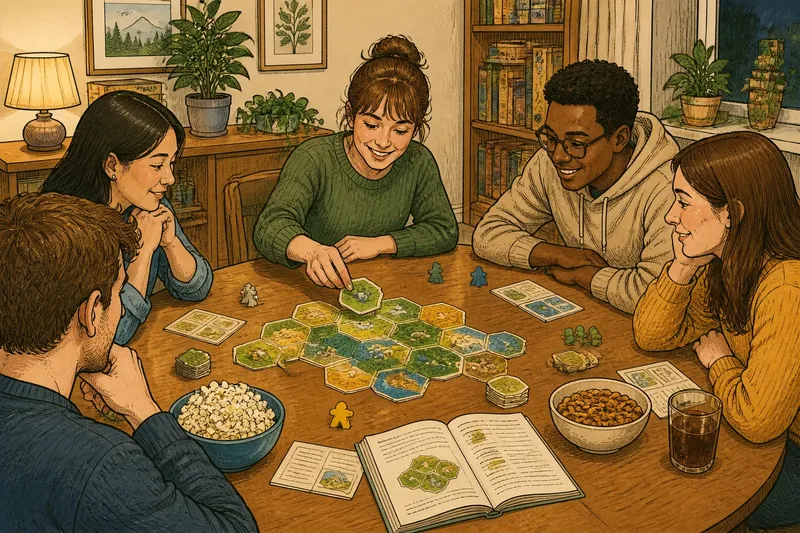
You have snacks on the table, friends settling into chairs, and a board game whose rulebook is thicker than the evening needs. A good first board-game evening doesn’t require a perfect explanation. Choose one short, welcoming game, teach only what someone needs to take a first turn, then let the table learn together.
How do I choose a game for a first board-game evening?
Pick a game that can be explained in a few minutes, has turns that are easy to see, and lets new players make a meaningful choice early. The goal is not to find the simplest game in existence; it’s to find one that suits this group and gives people something to do before their attention wanders.
Think about who is coming. A group that enjoys wordplay might warm to a clue-giving game. People who like arranging objects could prefer a tile-laying game. If the group is mixed, look for clear turns and low-pressure interaction: players can take part without needing to bluff, negotiate, or remember a long chain of special rules.
Check the game’s suggested player range, play time, age guidance, and any accessibility notes on the box or publisher’s instructions. Those details help you avoid a game that won’t fit the people or the available evening. A short game is especially useful because the group can decide afterward whether it wants another round or a different activity.
Before inviting everyone to learn a complex game, ask one simple question: can I describe what a player does on a turn in one or two sentences? If not, save it for another gathering.
How many games should I plan?
Plan one main game, not a parade of options. A single choice makes it easier to set up, explain, and begin. Bring a second game only as a quiet backup in case the first doesn’t suit the group; don’t put a stack of boxes on the table and ask newcomers to choose among unfamiliar titles.
Prepare the selected game before people arrive. Read the rules, sort pieces into sensible piles, and check how the game ends. If it uses cards, find out whether they need shuffling or a particular starting arrangement. Keep the rulebook within reach rather than treating it as a script to deliver aloud.
Say, “I thought we’d try this one first; after a round, we can decide what sounds fun next.” That gives the evening direction without making the game feel like an obligation.
What should I explain before the first turn?
Explain the aim, the basic shape of a turn, and any rule that would make a first move confusing or costly to reverse. Then start. Players rarely need to hear every exception before they have seen the board, cards, or tokens in action.
A compact introduction might cover:
- The aim: what players are trying to do, in plain language.
- A turn: the usual action or choice a player makes.
- The visible pieces: what the main cards, spaces, or tokens represent.
- The end: what signals that the game is over and how the winner or result is decided.
- One early exception: only if it could change what someone should do on the first turn.
For example, imagine you’re introducing a tile-laying game. You might say, “We’re building a shared landscape; on your turn, place one tile so its edges match the pieces beside it. The game ends when the tiles run out, and we’ll score the connected areas then.” Point to a sample placement, invite the next player to choose, and explain a scoring detail when it becomes relevant.
That’s enough to begin. Keep the explanation spoken and visual: point to a card or move a spare piece to show what you mean. A long account of every possible move can make a simple game sound like homework.
How do I teach rules while people are playing?
Teach a rule just before the group needs it, then show it on the table. If a player draws a card with a special effect, explain that effect when it appears. If scoring happens at the end, save the detailed scoring explanation until the group can see what has accumulated.
It helps to separate essential rules from optional reminders. Essential rules affect what a player can do now. A reminder might help people remember a useful possibility, but it doesn’t need to interrupt the turn. Ask, “Want a quick reminder of your options?” rather than taking over someone’s decision.
When a rule is unclear, pause briefly and check the rulebook together. If the answer is difficult to locate, agree on a temporary interpretation, make it clear that you’re doing so, and keep the game moving. A friendly table can tolerate an imperfect ruling more easily than a lengthy debate over a small point.
Let people change a move during the first round if the group agrees and no hidden information has been revealed. That makes trying a choice less intimidating. Once everyone understands the flow, use the rules as written or agree on a house rule for future rounds.
How do I make the evening comfortable for newcomers?
Make it easy to ask questions and easy to pass. Tell the group that questions are welcome and that anyone can watch a turn before playing. Avoid teasing people for a mistake or treating a win as proof that someone understood the rules best.
Arrange the table so everyone can see the shared pieces. Keep drinks and snacks away from cards and boards, and leave enough room for players to reach what they need. If someone has trouble seeing small print or hearing the explanation, offer a practical adjustment: read a card aloud, bring the board closer, or let that person choose a seat with a clearer view.
Keep the pace unhurried. A pause to think is part of playing, not a problem the host must solve. If a turn stalls, offer a neutral prompt such as, “Would it help to hear the options again?” Then let the player decide.
What if someone asks a question I can’t answer?
Say you’re unsure, and check the rulebook instead of bluffing. Look for the index, glossary, or section named by the question; if the wording still leaves room for interpretation, let the group settle on a temporary answer and move on. One unresolved detail should not become the whole evening.
What should I say if someone asks, “Can I change my move?”
For a first game, you can usually allow a correction if the move hasn’t revealed hidden information or affected another player. State the agreement before changing anything, so everyone knows the same rule applies to the table.
How do I handle a player who already knows the game?
Ask that person to help demonstrate a turn without explaining every strategy or taking decisions for others. A useful prompt is, “Could you show what a normal turn looks like, then let everyone choose for themselves?”
What if the game isn’t working for the group?
Offer a pause after the current round and ask whether people want to continue, switch games, or simply chat. A game night is a gathering, not a commitment to finish a box, and a gracious change of plan can keep the evening comfortable.
How should I end the first board-game evening?
When the game ends, give the group a moment to react before launching into a rematch or a detailed post-game analysis. Ask what people enjoyed or found confusing, and listen for practical signals: a favorite moment, a rule that needs a clearer explanation, or interest in trying again another time.
If the group wants another round, keep the same game and let everyone apply what they have just learned. If people are ready to stop, thank them and put the pieces away together. There is no need to turn a pleasant evening into a regular club unless the group asks for one.
A first board-game evening works best when the rules serve the gathering rather than dominate it. Choose one suitable game, explain what players need for the first turn, and make questions ordinary. The next useful choice is simple: keep the box where you can find it, so a future invitation can be as low-key as the first one.