Why a Sketchbook Changes What You Notice
A sketchbook trains your eye to notice shape, spacing, and small differences, with a low-pressure way to begin using any paper and pencil.
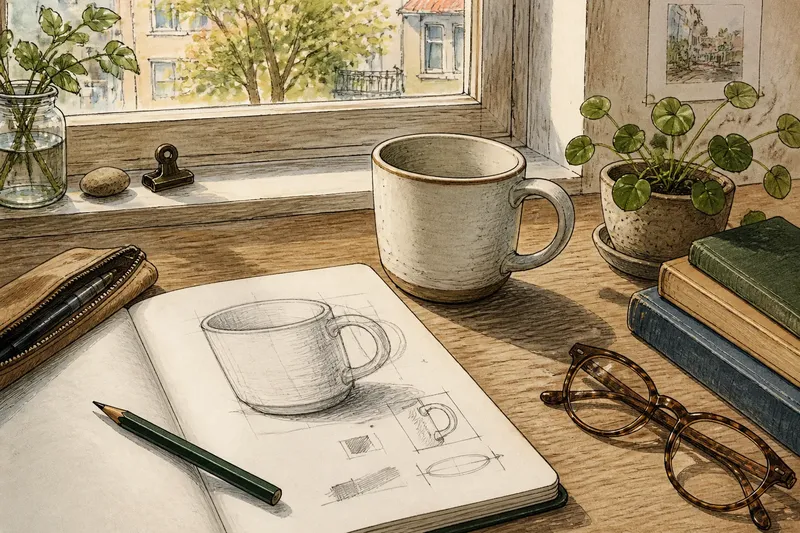
You set a mug beside the sink every morning, but today you draw it. The handle turns out to be wider than you thought, the rim is not quite level, and a thin crescent of shadow sits beneath the base. A sketchbook changes what you notice because drawing from observation asks you to look long enough to catch those details. You do not need a special book, a polished style, or a plan to become an artist. You need a subject in front of you and a few minutes of attention.
The useful question is not whether you are “good at drawing.” It is what kind of looking suits your day. A sketchbook can help you slow down, compare shapes, or remember a place through its details. Choose the approach that matches your circumstances, and let the page be a record of attention rather than a performance.
What do you want drawing to do for you?
If your days feel visually crowded, draw one ordinary object without trying to make it attractive. A spoon, houseplant, shoe, or folded towel offers clear edges and familiar proportions. Attend to where one part meets another: the spoon’s bowl and handle, a leaf and its stem, the fold crossing a sleeve. This kind of looking gives your mind a single, manageable subject.
If you want to remember a place, sketch a small arrangement rather than attempting a complete scene. At a café, that might be a cup near the edge of a table and the window frame behind it. At home, it could be a chair, a lamp, and the gap between them. The arrangement helps recall where things sat in relation to one another, not just the general impression of the room.
If you enjoy noticing tiny variations, choose repeated forms: leaves on a branch, buttons on a coat, or tiles along a wall. Look for differences in angle, spacing, and contour. The goal is not to correct the scene into a tidy pattern; it is to see where the pattern changes.
If you have little time or feel self-conscious, make the subject smaller. Draw one corner of a book, the outline of a key, or the shadow beneath a glass. A limited subject gives you a natural stopping point and leaves less room for the page to feel like an assignment.
Pick a subject that already holds your attention, even briefly.
How does drawing train your eye?
Looking at an object and drawing it are different activities. In ordinary viewing, your mind quickly supplies a familiar label: “mug,” “tree,” “shoe.” That shortcut is useful, but it can blur the exact shape in front of you. Drawing interrupts the shortcut. To put a line on paper, you have to ask where an edge begins, which way it bends, and how far it sits from another edge.
Shape becomes easier to see when you compare parts instead of relying on names. Is the opening of a mug round from your angle, or more like a narrow oval? Does the body taper toward the base? Is the handle’s inner opening taller than it is wide? You need not know the correct answer in advance. Checking the object and adjusting your marks is the practice.
Spacing matters just as much as contour. Look at the gap between a plant’s leaves, the space inside a handle, or the margin between a bowl and the edge of the table. These empty areas, sometimes called negative space, can be easier to compare than the object itself. If two objects seem oddly placed on the page, inspect the gap between them before changing either outline.
Small differences give observation its texture. Two leaves may share a general shape but differ in tilt, size, or the way their edges curl. A stack of books may look uniform until you notice one spine leaning and a thin strip of shadow below another. A sketchbook gives these distinctions somewhere to land, so they become easier to notice the next time you encounter a similar subject.
Which setup fits the time and place you have?
If you are at home with only scrap paper, use the back of an envelope, the margin of a grocery list, or a plain sheet from a printer. Any pencil that leaves a visible mark will do. The page does not need to be preserved; its job is to hold a few lines while you look.
If you want a page you can return to, choose a notebook that lies open comfortably. A bound sketchbook can keep drawings together, while loose sheets make it easy to work at a desk or pin a page nearby. Neither choice makes the drawing more serious. Choose the format that is easiest to reach and least likely to make you worry about wasting a page.
If you draw while waiting or traveling, a pocket notebook and a short pencil may suit you better than a large pad. A ballpoint pen is another option if it is already in your bag, though its marks are harder to erase. That can be freeing: instead of polishing a line, you can focus on comparing what you see with what you have drawn.
If you are unsure whether you want a regular practice, postpone buying supplies. Try a few sessions with the materials at hand, then notice what gets in the way. Perhaps the paper is awkward to hold, the pencil is too faint, or you prefer the ease of a bound page. Let a real friction point guide any later choice.
Put the materials where you are likely to sit, not where they look tidy.
What does a low-pressure first drawing look like?
Choose a still object in comfortable light: a cup, a citrus fruit, or a pair of glasses on a table. Set it where you can see the whole form without moving it. Take a moment to notice its outer shape, its tilt, and the spaces around it. Then draw lightly enough that you can change a line without treating the first mark as a verdict.
Say you choose a ceramic mug beside a window, and your first outline makes it look too narrow. Pause and compare the width of the rim with the height of the body. If the rim spans more of the page than your line suggests, widen it; if the handle sits too close to the cup, check the gap between them and shift the handle. The observable result you are aiming for is a drawing whose parts relate more closely to the mug you can see, not a flawless picture.
Keep the first sitting brief enough that you can stop while you are still curious. You might draw only the outer contour, then add one interior line where the handle joins the body. If you want to continue, mark the shadow beneath the mug or the oval of the rim. Leave some details out on purpose; selective looking is still looking.
When you finish, compare the page with the subject rather than judging it against an imagined ideal. Ask one concrete question: Which edge did I notice only after I started drawing? You can write a few words beside the sketch, or simply remember the answer. That small observation gives the next session somewhere to begin.
What should you try when a drawing feels wrong?
A drawing may feel wrong because a familiar object is not landing as the symbol you expected. You know a plate is round, for instance, so you draw a circle even though you are looking down at it from an angle. Check the visible shape rather than the object’s usual picture. From your seat, the plate may appear as a flattened oval.
If individual parts seem plausible but the whole looks off, compare their placement. Is the top of the bottle too close to the page edge? Does the plant’s widest leaf extend farther left than your drawing allows? You can lightly revise the larger relationship before adding detail. A few simple marks showing the top, bottom, and widest points may help you see the overall footprint.
If you are pressing hard or repeatedly erasing, switch to softer, shorter marks. Start with the broad outline and leave delicate features until later. Erasing can be useful, but it is not the only way to revise: a second line can show a changed judgment while the first remains as a trace of what you initially saw.
If the page begins to feel like a grade, stop adding demands. Turn to a fresh scrap, draw a simpler object, or close the notebook. You can return another day without completing the old page. The practice works best as an invitation to look, not a test you must pass.
What questions come up when starting a sketchbook?
Do I need a dedicated sketchbook?
No. Scrap paper, a notebook, or the back of an envelope can hold an observation just as well. A dedicated sketchbook is useful if keeping pages together makes it easier for you to return.
Should I draw from life or from a photograph?
Drawing from life lets you shift your viewpoint and inspect how light falls across an object. A photograph can be convenient when the subject is not nearby, but it fixes one angle and one moment.
What should I draw if I cannot think of a subject?
Look for one nearby object with a clear outline, such as a shoe, a plant, or a kitchen utensil. Choose the first detail you genuinely want to inspect, then draw only that part if a whole-object sketch feels too large.
How can I tell whether I am improving?
Look for changes in what you notice, not only for smoother lines. You may begin catching the angle of a rim, the spacing between leaves, or the way a shadow changes an object’s edge.
How can a sketchbook stay a place to notice?
Let the page hold uneven attempts, unfinished outlines, and small discoveries. You do not need to fill the book in order or make every drawing share a style. One page might contain a careful cup; the next, a quick note about the crooked shadow beneath a chair. Both can reflect attentive looking.
When you want a gentle way to begin, set out any paper and pencil, choose an object within reach, and look for one relationship: an edge, a gap, or a difference between repeated shapes. A sketchbook changes what you notice by giving your attention a place to pause. The next time you pass that familiar mug, you may see its rim before you think of its name.