The Finished-Project Myth: Plan Hobby Sessions Around the Time You Have
Plan hobby sessions around your available time, energy, and materials so you can make clear progress, practice a skill, or enjoy the activity without rushing.
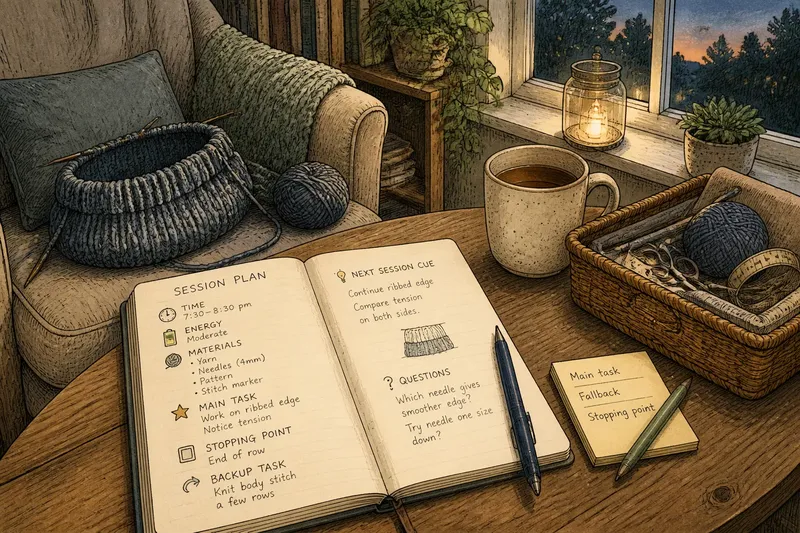
You have a clear evening for knitting, then discover the pattern calls for a stitch you barely remember. A session plan can keep that snag from turning into an all-or-nothing verdict: decide what fits the time, prepare what you need, and set a useful stopping point. Planning hobby sessions this way gives the project direction without making every evening a deadline.
A plan is not a promise to produce a particular amount. It is a small set of choices about what to do, what to do if conditions change, and how to leave the work ready for later. That makes planning especially useful when a hobby has several moving parts, from music practice to model building.
What belongs in a useful session plan?
Keep the plan close to the actual conditions of the session. Note the time you have, the materials on hand, the task you want to attempt, and a stopping point. If the task depends on something uncertain—an unfamiliar technique, a missing tool, a tired evening—write down a smaller alternative.
For instance, a watercolor session might call for a specific brush and a clean sheet of paper. If the brush is missing, the plan can switch to mixing colors with a different brush or sketching a composition in pencil. The point is not to anticipate every inconvenience; it is to prevent one obstacle from erasing the whole session.
A practical plan often includes:
- Available time: Check when you need to stop; if the task cannot fit, choose one section rather than rushing the whole piece.
- Energy and attention: Notice whether you feel alert or drained; if focus is low, choose a familiar or low-effort activity instead of a demanding new technique.
- Materials and tools: Set out what the task needs; if something essential is missing, switch to a task that uses what you have or pause to gather the missing item.
- One main task: Name a specific action, such as joining two quilt blocks; if it feels too broad, reduce it to one seam or one decision.
- A stopping point: Choose an observable end, such as finishing a row or putting away wet paint; if that point is too far off, stop at the next safe pause in the process.
- A backup task: Pick a related action that does not rely on the main task; if the original plan is blocked, use the backup, such as sorting beads while waiting for glue to set.
Keep the plan where the work happens: beside the knitting basket, in a music notebook, or on a scrap of paper next to the workbench. A plan you can see is easier to adjust than one you have to reconstruct from memory.
How do you match the task to the session?
Think in terms of a main task and a smaller fallback. The main task moves the hobby forward; the fallback keeps the session possible if time, concentration, or materials change. Neither needs a grand finish.
Imagine you have a half-finished knitted hat, one quiet evening, and enough yarn to continue. You want to work on the ribbed edge, but you are unsure how to keep the tension even. First, you check the pattern and place the needed needles and yarn beside your chair. Next, you make the main task “work on the ribbed edge and notice whether the stitches stay consistent”; your fallback is to knit a few rows of the familiar body stitch if the edge feels frustrating. You stop at the end of a row, where the work can be set down neatly. The result is a defined piece of progress or, if the technique proves distracting, a few familiar rows and a clear note to revisit the edge. Either outcome tells you what to pick up next.
That kind of plan gives the session a shape without treating the plan as a contract. If the main task turns out to be more involved than expected, use the fallback or stop at a sensible point.
What should change when plans meet real life?
Plans are most useful when they can bend. A hobby session might start late, a tool may need cleaning, or your attention may be elsewhere. Rather than trying to squeeze the original task into changed conditions, compare what is now available with what the task needs.
Use a quick decision:
- If you still have enough time and the materials are ready, continue with the main task.
- If time has narrowed, choose the smallest complete portion of that task.
- If a required tool or material is missing, switch to the backup or prepare the next session.
- If concentration has dipped, choose a familiar task or stop at a safe pause.
For work involving tools, heat, blades, or wet materials, make the stopping point safe before you step away. Follow the equipment instructions and get qualified guidance when the task raises a safety concern.
Which session-planning questions come up most?
How long should I plan for a hobby session?
Plan for the time you actually have, rather than an ideal open afternoon. If you have only a short window, select a discrete action such as tuning a guitar or preparing a piece of fabric, and leave a longer task for another time.
What if I cannot finish the task I chose?
Choose a stopping point that leaves the work stable and easy to resume, such as completing a row or marking the next cut on a pattern. If the task proves too large, note the next small action so you do not have to decide from scratch later.
Should I keep notes after every session?
Only if notes help you return to the activity. A brief line such as “try the left-hand chord change slowly” or “blue glaze still needs attention” can preserve a useful cue; if writing feels like another chore, skip it.
How do I plan when my energy is unpredictable?
Give yourself a main option and an easier alternative. If you feel focused, start the more demanding task; if you feel worn out, switch to the familiar activity or a simple preparation task.
How do you make the next session easier to start?
Before putting everything away, leave a clear cue for your future self. Set out the next tool, mark the place in a pattern, save the music passage, or write down the question that came up. A useful cue is specific enough to prompt action: “compare the two clay handles” is clearer than “work on the pot.”
When you return, check the cue against your current time and energy rather than following it automatically. If the plan still fits, begin there; if it does not, choose a smaller task or a different activity. Planning hobby sessions works best when it supports the practice you want to keep, not when it becomes another project demanding completion.
Before your next session, write down one main task, one fallback, and a stopping point. That small plan can make it easier to begin—and easier to leave the work in good shape for another day.